Setting up laser ventilation
Quick answer
Size a laser exhaust setup so airflow through the duct lands between 1000 and 2000 feet per minute, not just by a fan's printed free-air CFM rating; a 4 inch duct run stays in that band up to roughly 175 CFM, which fits fans like the VIVOSUN D4 195 CFM inline fan ($27.89) or the Voltset 280 CFM inline fan ($44.99) once duct length and bends are accounted for.
The CFM and duct velocity formulas below are standard airflow math; the 6 to 10 second air change target and the resulting CFM ranges are shop convention, not a code requirement.
What CFM do I need for a laser enclosure?
Cubic feet per minute needed works out to the enclosure volume in cubic feet multiplied by 60 divided by the seconds you want per full air change. A laser wants a complete air change roughly every 6 to 10 seconds so smoke does not have time to build up around the cutting head between exhaust cycles. A typical desktop enclosure of 0.1 to 0.2 cubic metres works out to roughly 40 to 90 CFM on that basis, which is why most desktop-class inline fans are rated somewhere in the 130 to 280 CFM range: that headroom covers duct losses, not just the bare enclosure number.
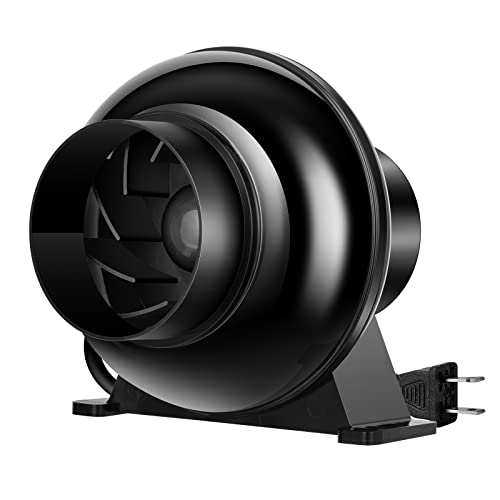
That headroom matters because the CFM printed on a fan box is a free-air rating, measured with nothing attached to the fan at all. The moment you connect duct, add bends, or run it any real distance, actual delivered airflow drops below that number. Buying a fan rated exactly at your calculated minimum usually leaves you short once the duct is connected.
How do I size the duct once I have a fan?
Once you know your target CFM, duct velocity in feet per minute works out to CFM divided by the duct's cross-sectional area in square feet. The target band is 1000 to 2000 fpm. Below 1000 fpm, air moves too slowly to carry soot and fine particulate along the duct, and it settles inside the run instead, gumming things up over time. Above 2000 fpm, the setup gets noisy and static pressure climbs fast, which fights the fan and cuts real delivered airflow further.
A 4 inch duct suits most desktop lasers and stays inside that 1000 to 2000 fpm band up to roughly 175 CFM, which covers every desktop fan in this category. Going up to 5 or 6 inch duct only makes sense once your target CFM is genuinely higher than that, since oversized duct at low CFM just drops velocity below the useful range.
Why does flexible duct cost so much airflow versus rigid duct?
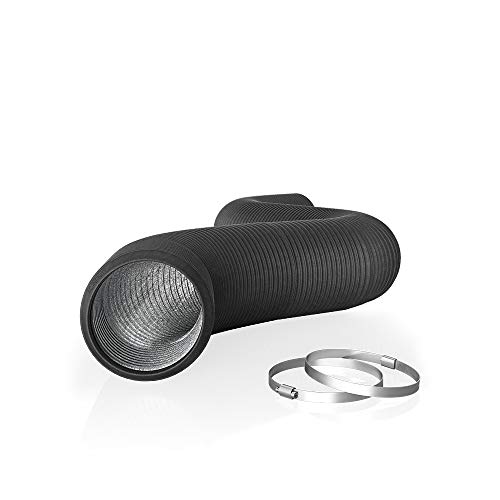
Flexible aluminum ducting has a corrugated interior, and that ribbed surface creates roughly 2.5 times the static pressure of smooth rigid duct carrying the same airflow. Every foot of flex duct in a run fights the fan harder than the same foot of smooth pipe would. It is still the practical choice for most desktop setups because it is cheap and easy to route, but stretching it fully taut and avoiding excess slack recovers a meaningful amount of that lost performance.
How many bends can my duct run have before performance drops too much?
Each 90 degree bend adds roughly 5 feet of equivalent straight-duct length to the run, in terms of the resistance it adds. A run with three bends and 8 feet of actual duct behaves, for airflow purposes, more like a 23 foot straight run. This is why a fan that looks comfortably oversized on paper can still deliver disappointing airflow at the cutting head: the equivalent length from bends is easy to undercount when you are only measuring the duct with a tape.
Should I vent outside or use a fume extractor instead?
Venting outside through duct and an exhaust fan removes fumes from the room completely and is the better default whenever a window, wall port, or existing vent makes it possible. A carbon and pre-filter fume extractor, such as the KQZ 150W unit ($99.00) or a dedicated filter set like the FumeClear replacement filters ($65.00), is the fallback for a room with no outside access. A filter loads up with use and its capture rate declines as it does, often with no clear smell or warning to tell you it has stopped working well.
How do I know my ventilation setup is actually working?
The practical signs are a duct run that feels warm and slightly moving to the touch along its whole length rather than just near the fan, no soot streaking visible at duct joints, and no smoke smell lingering in the room a few minutes after a cut finishes. If smoke visibly hangs over the cutting area during a job instead of being pulled away immediately, the setup is undersized, has too many bends for the fan installed, or the duct run has a kink restricting flow somewhere out of sight.
| CFM through the duct | Velocity in a 4 inch duct | Result |
|---|---|---|
| 50 CFM | about 570 fpm | too slow, soot settles inside the duct over time |
| 90 CFM | about 1030 fpm | low end of the target band |
| 130 CFM | about 1490 fpm | comfortably inside the target band |
| 175 CFM | about 2005 fpm | top of the target band for 4 inch duct |
Equipment mentioned here
- AC Infinity
AC Infinity Flexible 4-Inch Aluminum Ducting, 8-Feet Long
$12.99 Check pricePrices change often - VIVOSUN
VIVOSUN 4 Inch Flex Aluminum Ducting, 8 Ft Air Duct with 2 Clamps, Silver
$13.99 Check pricePrices change often - VIVOSUN
VIVOSUN P4 4" Inline Fan &Speed Control 130 CFM Exhaust Fan for Home
$26.39 Check pricePrices change often - VIVOSUN
VIVOSUN D4 4" AC Motor Inline Fan, 195 CFM for Ventilation
$27.89 Check pricePrices change often - Voltset
Voltset 4 Inch Duct Fan 280 CFM Inline Ventilation Exhaust Fan
$44.99 Check pricePrices change often




Safety
Common questions
What CFM does a typical desktop laser enclosure need?
A desktop enclosure of roughly 0.1 to 0.2 cubic metres needs approximately 40 to 90 CFM to achieve a full air change every 6 to 10 seconds. Because fan CFM ratings are measured in free air, buy a fan rated well above that minimum so duct length and bends still leave enough real delivered airflow.
What size duct should I use for a desktop laser?
4 inch duct fits nearly every desktop laser and keeps airflow inside the 1000 to 2000 fpm target band up to roughly 175 CFM. Only step up to a larger diameter if your calculated CFM need is genuinely above that, since oversized duct at low CFM drops velocity too far and lets particulate settle.
Why is flexible duct worse than rigid duct for laser exhaust?
The corrugated interior of flexible aluminum ducting creates roughly 2.5 times the static pressure of smooth rigid duct at the same airflow, so a flex run needs more fan power to move the same air. Pulling the duct fully taut and removing slack reduces this penalty but does not eliminate it.
How much does a 90 degree bend cost me in airflow?
Each 90 degree bend adds roughly 5 feet of equivalent straight-duct resistance to the run. A short duct run with several bends can behave like a much longer straight run for airflow purposes, which is why fan sizing should account for bend count, not just the physical duct length.
Should I trust the CFM number printed on the fan box?
Treat it as a ceiling, not a guarantee. Fan CFM ratings are measured in free air with nothing attached, and real delivered airflow through an actual duct run with bends and length is considerably lower. Size the fan with margin above your calculated minimum rather than buying to the exact number.