50 CFM through a 20 foot run
Quick answer
At 50 CFM, a 3 inch duct gives about 1019 feet per minute, which sits inside the 1,000 to 2,000 fpm band that carries smoke without settling. A 20 foot flexible run behaves like roughly 50 feet of smooth pipe.
Airflow equals velocity times area, which is standard. The target velocity band and the flexible duct penalty are conventions from ventilation practice.
| Duct size | Velocity | Verdict |
|---|---|---|
| 3 inch | 1019 fpm | Good |
| 4 inch | 573 fpm | Too slow, particulate settles |
| 5 inch | 367 fpm | Too slow, particulate settles |
| 6 inch | 255 fpm | Too slow, particulate settles |
| 8 inch | 143 fpm | Too slow, particulate settles |
| Duct type | Equivalent length | Effect |
|---|---|---|
| Smooth rigid | 20 ft | Baseline, lowest pressure loss |
| Flexible | 50 ft | Corrugations create turbulence along the whole length |
| Each 90 degree bend | +5 ft | Add this per bend, on top of the run |
Why velocity matters more than size
The goal is not simply to move air, it is to move it fast enough that soot and resinous particulate stay suspended all the way to the outside. Below roughly 1,000 feet per minute that material drops out inside the duct, and over months the run gums up, smells, and eventually restricts the airflow it was installed to carry.
Too fast is a milder problem but a real one. Above about 2,000 feet per minute the run gets audibly noisy and the static pressure the fan has to overcome climbs steeply, so you buy a larger fan to push air through a duct that is fighting you. At 50 CFM the 3 inch size lands in the useful middle.
The run is longer than it measures
A 20 foot run of flexible duct does not behave like 20 feet of pipe. The corrugations inside generate turbulence along the entire length, costing several times the pressure of smooth rigid duct, so it behaves closer to 50 feet. Every 90 degree bend adds roughly another 5 feet on top.
The practical consequence is that a fan rated at 50 CFM in free air will deliver noticeably less than that through a real installation. Use rigid pipe for the straight sections, keep flexible duct for the short final connection, and take bends out of the path wherever the layout allows.
Fans and ducting
- AC Infinity
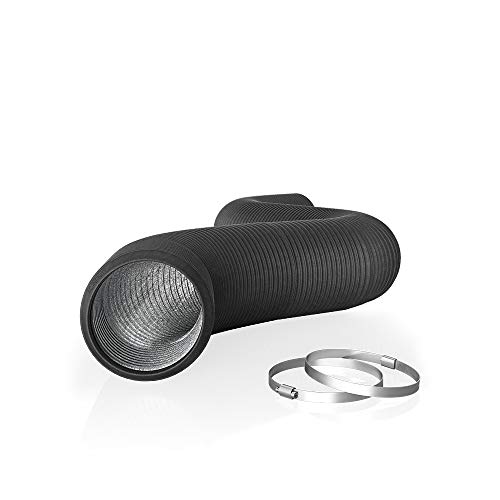
AC Infinity Flexible 4-Inch Aluminum Ducting, 8-Feet Long
$12.99 Check pricePrices change often - VIVOSUN
VIVOSUN 4 Inch Flex Aluminum Ducting, 8 Ft Air Duct with 2 Clamps, Silver
$13.99 Check pricePrices change often - VIVOSUN
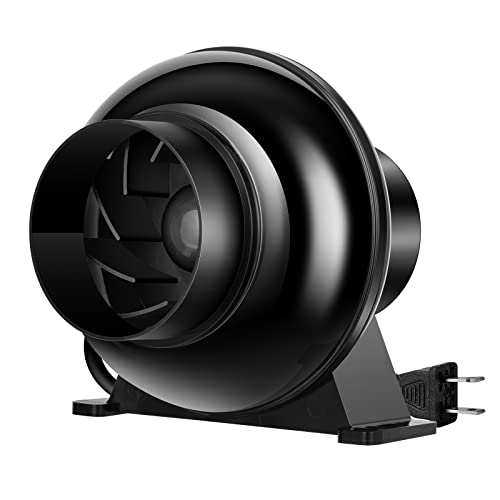
VIVOSUN P4 4" Inline Fan &Speed Control 130 CFM Exhaust Fan for Home
$26.39 Check pricePrices change often - VIVOSUN
VIVOSUN D4 4" AC Motor Inline Fan, 195 CFM for Ventilation
$27.89 Check pricePrices change often - Voltset
Voltset 4 Inch Duct Fan 280 CFM Inline Ventilation Exhaust Fan
$44.99 Check pricePrices change often




Common questions
Is a 4 inch duct enough for 50 CFM?
Yes. At 50 CFM a 4 inch duct runs at about 573 feet per minute, which is inside the sensible band. Four inch is the most common size on desktop machines and it covers the great majority of them.
Can I use dryer vent hose?
The thin foil type is a poor choice for anything permanent. It tears easily, it collapses at bends which chokes the airflow exactly where it is already weakest, and it has the full corrugation penalty. Semi rigid aluminium is a considerable improvement for little extra money, and smooth rigid pipe is better again.
Does the fan rating mean what it says?
It is measured in free air, with no duct attached at all, so it is the best case the fan will ever achieve. Through a real run with bends and flexible sections you should expect meaningfully less. Size the fan with headroom rather than buying exactly the figure you calculated.
Should I vent outside or filter?
Vent outside whenever a window or wall penetration is possible. A carbon filter removes odour and some particulate while the carbon has capacity, then stops working with no warning that it has, and its capacity falls quickly under heavy cutting. Filtration is the answer when venting is genuinely impossible, not an equal alternative.