Brass vs hardened steel nozzles: which one should be on your hotend
Quick answer
Keep a brass nozzle, such as a 16-piece MK8 brass set at $7.19, on your hotend for PLA, PETG, ABS and ASA, since brass conducts heat well and those filaments are not abrasive. Switch to a hardened steel nozzle, like the Mudder 0.4 mm 5-pack at $8.49, the moment you load a filled filament such as carbon fibre, glass fibre or glow in the dark, because those abrasive particles will measurably widen a brass nozzle's opening within a single large print.
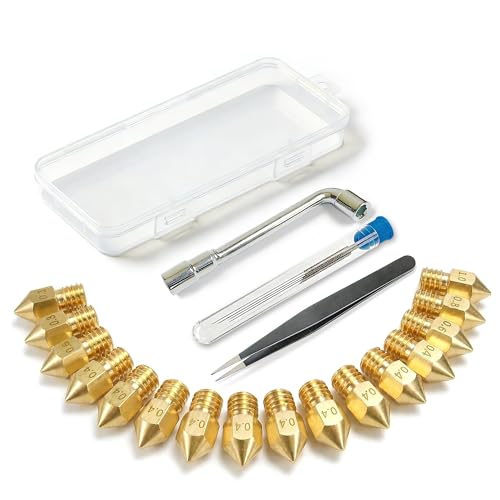
3D Printer Nozzle Kit, 16PCS MK8 Brass Nozzles 0.2/0.4/0.6/0.8/1.0mm
PLA, PETG, ABS and ASA, plain unfilled filaments where thermal performance matters most
| Brass nozzle | Hardened steel nozzle | |
|---|---|---|
| Thermal conductivity | Higher, heats and responds to temperature changes faster | Lower, a real but minor cost in responsiveness |
| Works well on | PLA, PETG, ABS, ASA, and other unfilled filaments | Carbon fibre, glass fibre, glow in the dark, and other filled filaments |
| Wear from abrasive filament | Measurably widens within a single large print | Resists wear and holds its diameter across many prints |
| Typical cost | Usually the cheaper of the two | Usually a few dollars more per nozzle |
| Risk of using the wrong one | Fine for unfilled filaments, no added risk | Using it on abrasives is required, skipping it wastes the nozzle and drifts extrusion width |
Why does brass wear out on filled filament so quickly?
Filled filaments carry hard particles suspended in the plastic, whether that is chopped carbon fibre, milled glass fibre, glow in the dark pigment, or the mineral fillers in some matte PLA blends. Every one of those particles gets forced through the nozzle's opening under pressure, and brass is soft enough that the particles grind against it on the way through. That erosion widens the opening, and it happens fast: a single large print in an abrasive filament can measurably open up a brass nozzle before the print even finishes.
Once that opening widens, the nozzle keeps extruding, just at a wider bead than the slicer was told to expect. Walls print thicker than programmed, dimensional accuracy drifts, and the part can come out slightly oversized in ways that are hard to diagnose if you do not know the nozzle itself has changed shape.
Does hardened steel cost you anything on standard filaments?
Yes, a real one. Hardened steel conducts heat less efficiently than brass, so it responds more slowly to temperature changes and can make it slightly harder for a hotend to keep up with fast flow rates at a given temperature. It is a minor cost, not a dealbreaker, but it is also not a reason to run hardened steel on filaments that do not need it. There is no upside to accepting that slower thermal response if you are only ever printing plain PLA or PETG.
How do you know if your filament actually needs hardened steel?
Check whether the filament is filled. Carbon fibre and glass fibre blends are the clearest cases, since the reinforcing fibres are exactly the kind of hard particle that erodes brass. Glow in the dark filament is filled too, with phosphorescent pigment particles that behave the same way inside the nozzle. Some matte or textured PLA formulations also carry abrasive filler to get their finish. Plain PLA, PETG, ABS and ASA are not abrasive, and brass handles all of them without issue.
What happens if you keep printing filled filament through a worn brass nozzle?
The problem compounds. As the opening widens further, the extrusion width keeps drifting wider than what the slicer calculated, which shows up as walls that run thicker than designed, layer lines that look inconsistent, and dimensional tolerances that get worse the longer that nozzle stays in service. There is no way to restore a worn brass nozzle to its original diameter, so the fix is always a replacement, and the way to avoid the repeat cost is switching to hardened steel before the next filled spool goes on the printer.
Hardened steel nozzle
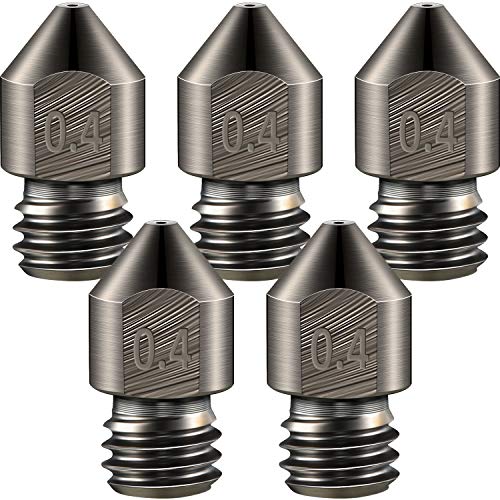
Mudder 5 Pcs Hardened Steel Nozzles 0.4mm Mk8 3D Printer Nozzles
carbon fibre, glass fibre, glow in the dark and other filled filaments that carry abrasive particles
Both sides of this comparison
- LKNNEASTO
3D Printer Nozzle Kit, 16PCS MK8 Brass Nozzles 0.2/0.4/0.6/0.8/1.0mm
$7.19 Check pricePrices change often - Mudder
Mudder 5 Pcs Hardened Steel Nozzles 0.4mm Mk8 3D Printer Nozzles
$8.49 Check pricePrices change often - XIFOWE
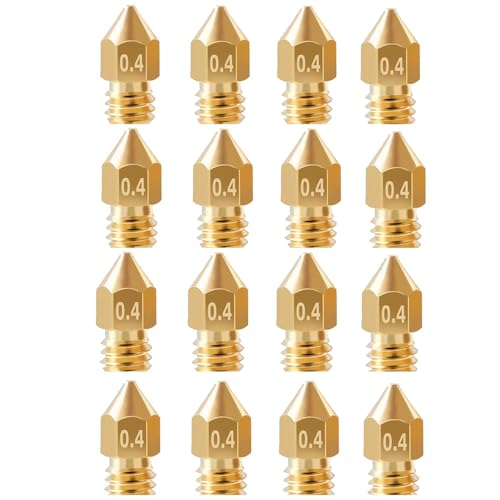
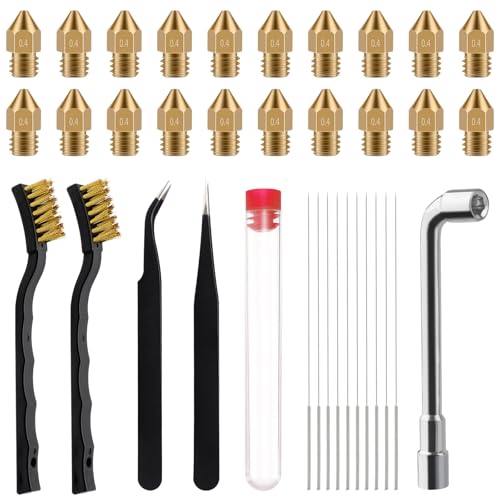
XIFOWE MK8 Nozzles 25 pcs 0.4mm 3D Printer Extruders Brass Nozzles
$9.99 Check pricePrices change often


Safety
Common questions
Can a hardened steel nozzle be used with any filament?
Yes, hardened steel works fine across PLA, PETG, ABS, ASA and filled filaments alike. The only trade-off is its lower thermal conductivity compared to brass, which is a minor cost rather than a reason to avoid it, so it is a safe default if you print a mix of materials and do not want to keep swapping nozzles.
How fast does a brass nozzle wear out on carbon fibre filament?
Fast enough to matter within a single print. Carbon fibre's reinforcing particles grind against the soft brass every time filament is pushed through, and that erosion can measurably widen the nozzle's opening before a single large print even finishes, which is why hardened steel is treated as required rather than optional for this material.
Do I need hardened steel for glow in the dark filament?
Yes. Glow in the dark filament contains phosphorescent pigment particles that are abrasive in the same way carbon fibre or glass fibre are, even though it looks and prints similarly to plain PLA otherwise. A brass nozzle will wear from it just as it would from any other filled filament.
Why does my nozzle opening seem bigger than the size printed on it?
If you have run any filled filament through a brass nozzle, abrasive wear is the likely cause. The particles in filaments like carbon fibre or glow in the dark erode the soft brass as it passes through, widening the actual opening beyond its labeled diameter, which then shows up as thicker than expected walls and drifting dimensional accuracy.
Is there a cheaper way to protect a brass nozzle from filled filament?
Not really. The only reliable option is keeping brass reserved for unfilled filaments and switching to a hardened steel nozzle before loading anything filled. There is no coating or technique that lets a brass nozzle resist abrasive wear the way hardened steel does.