How CO2 lasers work
Quick answer
A CO2 laser generates its beam by running an electrical discharge through a sealed tube of carbon dioxide, nitrogen and helium gas, producing light at 10.6 micrometers (10,600 nanometers), a far infrared wavelength invisible to the eye. A desktop machine such as the OMTech K40+ ($669.99) uses mirrors to route that beam from the tube to a focusing lens, and the wavelength is why it cuts clear acrylic cleanly while a diode laser cannot cut it at all.
The gas discharge mechanism, wavelength and spot size formula are published physics. The pass-count guidance and coating requirement for marking metal reflect common shop practice rather than one manufacturer spec.
What produces the beam inside a CO2 laser tube?
A CO2 laser tube is sealed or gas-flowing glass or ceramic filled with a mixture of carbon dioxide, nitrogen and helium. A high-voltage electrical discharge excites the gas molecules, and as they release that energy they emit light at 10.6 micrometers, deep in the far infrared and well outside what the human eye can see. Mirrors at each end of the tube bounce the light back and forth to amplify it before letting a portion escape as the working beam.
From there, a series of steering mirrors on the gantry route the beam from the fixed tube to the moving focusing lens, which is a different arrangement from a diode laser, where the diode chip itself rides on the gantry. This is also why most CO2 tubes need an active water cooling loop, typically a pump and reservoir, to carry away the heat generated by the discharge, something a diode module rarely needs beyond a small fan.
Why is a 10.6 micrometer wavelength considered so versatile?
A wavelength of 10.6 micrometers is strongly absorbed by a wide range of organic and mineral materials: wood, leather, paper, cardboard, glass, stone and both clear and colored acrylic. That broad absorption is why a CO2 laser handles more of a typical hobbyist material list without switching machines than a diode laser does.
Clear acrylic is the clearest example. It is transparent to the roughly 445 nanometer wavelength a diode laser emits, so a diode beam passes through it, but it absorbs 10.6 micrometer light strongly, so a CO2 laser cuts it cleanly and typically leaves a polished, almost flame-finished edge rather than a rough one.
Why won't a desktop CO2 laser cut or mark bare metal?
Bare, uncoated metal reflects far infrared light and conducts heat away from the beam spot too quickly for a desktop CO2 laser to do useful work on it. A hobby-level tube simply does not have the power density to overcome that reflectivity and thermal spreading, so bare aluminum, steel or brass passes under the beam largely unaffected.
Marking metal with a CO2 laser normally requires a coating, a compound applied to the surface that absorbs the beam and transfers that heat into a thin bonded mark on the metal underneath. Without that coating, a desktop CO2 machine will not cut or mark bare metal at all.
How does lens focal length change a CO2 laser's spot size?
The same relationship applies to any focused laser: spot size equals 4 times the wavelength times the focal length, divided by pi times the beam diameter. Because a CO2 laser's wavelength of 10.6 micrometers is roughly 24 times longer than a diode laser's 445 nanometers, a CO2 beam with a similar focal length and beam diameter focuses to a larger minimum spot than a diode beam does.
CO2 machines commonly compensate with beam expanders and larger-diameter optics before the focusing lens, which brings the effective spot size back down. The same lens choices used across desktop lasers still apply: a 1.5 inch (38.1 mm) lens for fine engraving, a 2 inch (50.8 mm) lens as a general purpose default, a 2.5 inch (63.5 mm) lens for thicker cutting, and a 4 inch (101.6 mm) lens for thick stock, trading spot size against depth of field exactly as it does on a diode machine.
Why does clear acrylic cut so much cleaner on a CO2 laser than a diode laser?
This comes back to absorption, not machine quality. A diode laser cannot cut clear acrylic at any power because the material is transparent at its 445 nanometer wavelength; the beam passes through instead of heating the plastic. A CO2 laser's 10.6 micrometer beam is absorbed strongly by the same clear acrylic, converting to heat efficiently along the cut line, which both cuts through the sheet and melts the freshly cut edge into a smooth, glossy finish in the same pass.
Why do several fast passes usually beat one slow pass on a CO2 laser too?
The same debris logic that applies to a diode laser applies here. Each pass clears vaporized material and smoke out of the kerf so the next pass reaches material that has not already been shielded by char and soot. One slow pass instead concentrates heat for longer in one place, which widens the kerf, chars the edge more heavily on materials like wood and cardboard, and raises the risk of a flare-up. Running a job as several quicker passes at the same total energy typically gives a straighter, cleaner cut and an easier moment to catch a problem before it becomes a fire.
| Laser type | Wavelength | Visible? | Typical strength |
|---|---|---|---|
| Diode | Around 445 nm | Yes, blue light | Wood, leather, dark and colored acrylic |
| CO2 | 10.6 µm (10,600 nm) | No, far infrared | Clear acrylic, glass, wood, leather, stone |
| Fiber | 1064 nm | No, near infrared | Bare and coated metal marking |
Equipment mentioned here
- Kidde
Kidde Auto 5 Fire Extinguisher for Cars and Trucks, 5-B:C, M5G
$17.88 Check pricePrices change often - Kidde
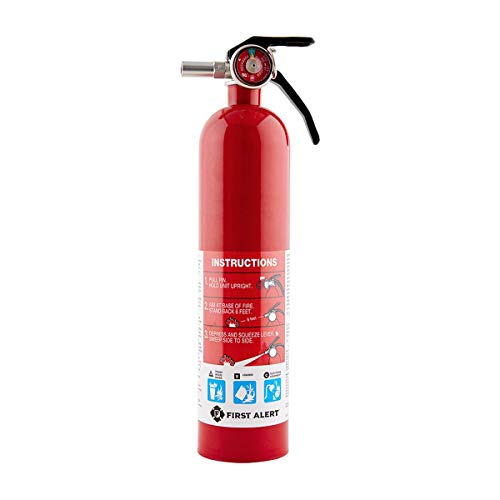
Kidde Basic 110 Fire Extinguisher for Home, 1-A:10-B:C, FA110G, 1 Pack
$19.97 Check pricePrices change often




Safety
Common questions
What gas is inside a CO2 laser tube?
A CO2 laser tube holds a mixture of carbon dioxide, nitrogen and helium gas. An electrical discharge excites the mixture, and the carbon dioxide molecules release that energy as light at 10.6 micrometers, which mirrors inside the tube amplify before it exits as the working beam.
Can a CO2 laser engrave or cut bare metal?
No, not without a coating. Bare metal reflects far infrared light and carries heat away too fast for a desktop CO2 tube to mark it. Marking metal with a CO2 laser normally requires a coating applied to the surface that absorbs the beam and bonds a mark into the metal underneath.
Why does a CO2 laser need water cooling when a diode laser usually does not?
A CO2 tube generates significant heat from the electrical discharge that produces the beam, and that heat has to be carried away continuously or the tube degrades and fails. Most CO2 setups use a water pump and reservoir loop for this. A diode module produces its beam directly in a semiconductor chip and typically only needs a small fan or passive heat sink.
Can I use diode laser safety glasses with a CO2 machine?
No. Glasses rated for a diode laser's roughly 445 nanometer wavelength give no protection against a CO2 laser's 10.6 micrometer beam, and the reverse is also true. Each machine needs eyewear rated specifically for its own wavelength, checked on the frame before every session.
Does a CO2 laser cut faster than a diode laser?
On comparable material and thickness, a CO2 laser generally cuts faster because its broader material absorption and typical higher power lets it clear a kerf in fewer passes. A diode laser remains competitive on thinner wood, leather and dark acrylic, often at a fraction of the price and footprint.