How FDM 3D printing works
Quick answer
FDM (fused deposition modeling) printers melt plastic filament through a heated nozzle and deposit it one thin layer at a time; a common 0.4 mm nozzle prints usable layers from about 0.10 to 0.30 mm tall, and a layer taller than the nozzle orifice physically cannot bond to the layer below it.
The material densities, the volumetric flow formula, and the physical limit tying layer height to nozzle diameter are physics and published specifications; the everyday layer height range and its 0.20 mm default are a widely used convention, not a hard rule.
What does FDM actually stand for, and what happens inside the printer?
FDM stands for fused deposition modeling. A spool of solid plastic filament, typically 1.75 mm in diameter, is pulled into a hotend where a heater block brings it above its melting point. A motor pushes softened plastic through a small nozzle opening, and the printer's motion system moves that nozzle in the shape of one cross-section of the part before the build plate steps down (or the nozzle steps up) for the next layer.
Every part is therefore a stack of two-dimensional outlines fused together vertically. The printer never sees the whole part at once; it only ever executes one layer's worth of motion at a time, reading instructions from a sliced file generated before printing starts.
How is a print built up, layer by layer?
Each layer starts as molten plastic squeezed out of the nozzle onto either the build plate or the layer beneath it. While still hot, that fresh plastic partially remelts the top of the previous layer, and the two fuse together as they cool. This is why print quality depends heavily on temperature control: too cold and layers do not fuse well; too hot and the part sags or strings between features.
The strength of a finished part comes largely from how well this layer-to-layer fusion happened, not just from the raw strength of the plastic. A part printed from strong filament with poor layer bonding will still fail along its layer lines under load.
Why can a layer never be taller than the nozzle?
This is a physical limit, not a setting. The nozzle orifice defines the maximum thickness of plastic it can deposit and press down against the previous layer. If the commanded layer height exceeds the nozzle diameter, the extruded plastic cannot make contact with the surface below it, and the layer will not bond at all. That is why every slicer restricts layer height to something meaningfully smaller than nozzle diameter, never larger.
How is horizontal detail different from vertical smoothness?
These two qualities are set by two different numbers, and confusing them is one of the most common mistakes newer users make. Nozzle diameter sets the finest horizontal detail a printer can trace, since it is literally the width of the line the printer draws in each layer. Layer height sets vertical smoothness: how visible the stair-stepping is on a sloped or curved surface.
A smaller nozzle does not make layers thinner by itself, and a shorter layer height does not sharpen horizontal detail. A part with fine vertical text needs a small nozzle; a part with smooth curved surfaces needs a short layer height. Both can be true requirements on the same model.
What is volumetric flow, and why does it limit print speed?
Volumetric flow is layer height multiplied by line width multiplied by print speed, measured in cubic millimeters per second (mm3/s). It describes how much molten plastic a hotend has to melt and push out every second, and every hotend has a ceiling on that number no matter what speed is typed into the slicer.
A stock PTFE-lined hotend typically manages roughly 12 mm3/s, an all-metal hotend around 20 mm3/s, and a high-flow hotend design around 32 mm3/s. Past that ceiling, the plastic will not fully melt on the way through, and the print starts skipping steps, under-extruding, or grinding filament against the drive gear.
What materials does an FDM printer typically run, and how do they differ?
The common desktop materials are PLA, PETG, ABS, ASA and TPU, and each has its own density: PLA is about 1.24 g/cm3, PETG about 1.27 g/cm3, ABS about 1.04 g/cm3, ASA about 1.07 g/cm3, and TPU about 1.21 g/cm3. Density matters directly for cost, since filament is sold by weight: a denser material yields less usable length from the same 1 kg spool.
Materials also flow at different rates through the same hotend. PETG flows at roughly 75 percent of PLA's rate at a given temperature and pressure, and flexible TPU flows at only around 35 percent of PLA's rate, which is one reason TPU prints are set noticeably slower than PLA prints on the same machine.
What safety issues come with running an FDM printer?
PLA is the lowest-fume common filament and is reasonable to run in an open room. ABS and some other filaments release VOCs and ultrafine particles while printing, and putting the printer inside an enclosure without also adding extraction makes this worse, not better, since an enclosure traps and concentrates fumes rather than clearing them. Anyone printing ABS or ASA regularly indoors should pair an enclosure with real ventilation or a fume extractor, not one or the other.
| Material | Density (g/cm3) | Typical role |
|---|---|---|
| PLA | 1.24 | Everyday default, indoor and low-stress parts |
| PETG | 1.27 | Tougher parts, mild heat and moisture exposure |
| ABS | 1.04 | Indoor functional parts needing more heat tolerance |
| ASA | 1.07 | Outdoor parts exposed to UV |
| TPU | 1.21 | Flexible parts, gaskets, vibration damping |
Equipment mentioned here
- LKNNEASTO
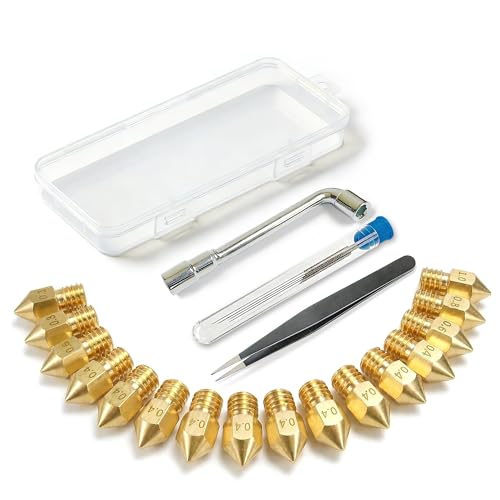
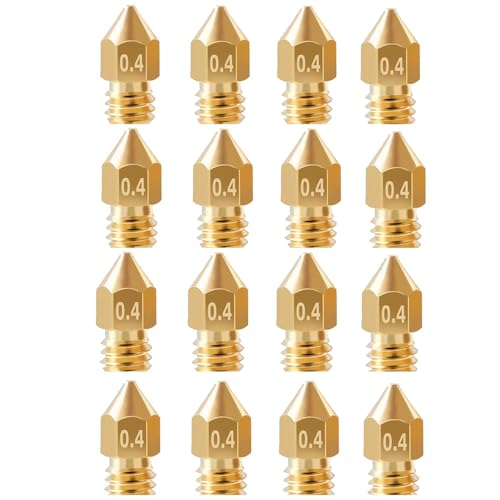
3D Printer Nozzle Kit, 16PCS MK8 Brass Nozzles 0.2/0.4/0.6/0.8/1.0mm
$7.19 Check pricePrices change often - Mudder
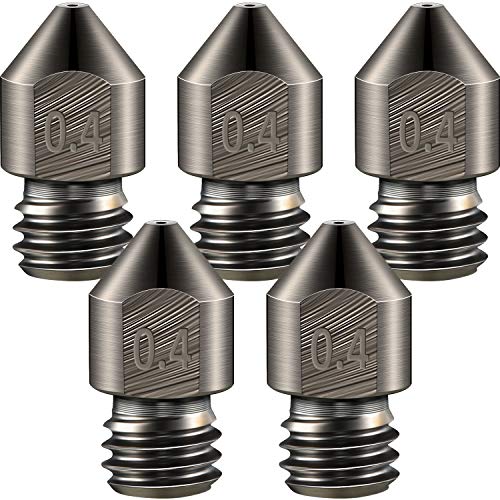
Mudder 5 Pcs Hardened Steel Nozzles 0.4mm Mk8 3D Printer Nozzles
$8.49 Check pricePrices change often - XIFOWE
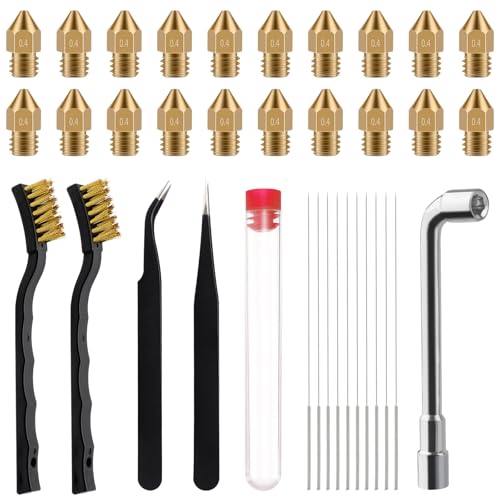
XIFOWE MK8 Nozzles 25 pcs 0.4mm 3D Printer Extruders Brass Nozzles
$9.99 Check pricePrices change often


Safety
Common questions
What does FDM stand for?
FDM stands for fused deposition modeling, the process of melting plastic filament through a heated nozzle and depositing it one layer at a time to build a solid part. It is the most common type of desktop 3D printing, distinct from resin-based printing, which cures liquid resin with light instead of melting plastic.
What is the difference between line width and layer height?
Line width is how wide a single extruded strand of plastic is within one layer, typically around 1.1 times the nozzle diameter. Layer height is how tall each stacked layer is. Line width affects horizontal strength and detail; layer height affects vertical smoothness and print time. They are set independently in the slicer.
Why can I not just print a taller layer to finish faster?
A layer height greater than the nozzle diameter cannot make proper contact with the layer beneath it, so it will not bond. This is a physical limit of the nozzle geometry, not a conservative software restriction, which is why slicers cap layer height well under nozzle diameter rather than at it.
Why does volumetric flow matter more than the speed number in mm/s?
Two prints running the same speed in mm/s can demand very different amounts of molten plastic per second depending on layer height and line width. Volumetric flow, layer height times line width times speed, captures the real load on the hotend. A setting can look fast on paper and still exceed what the hotend can actually melt.
Which FDM filament is easiest to start with?
PLA is the standard starting material. It has a density of about 1.24 g/cm3, produces the least fumes of the common filaments, and is far more tolerant of imperfect slicer settings than PETG, ABS, ASA or TPU. Most beginners learn the basics of layer adhesion and bed leveling on PLA before moving to tougher materials.