Slicer settings explained
Quick answer
Volumetric flow, layer height multiplied by line width multiplied by speed, is the real limit on slicer settings, in cubic millimeters per second (mm3/s): a stock PTFE hotend manages roughly 12 mm3/s, an all-metal hotend around 20, and a high-flow hotend around 32.
The volumetric flow formula, the hotend flow figures, and the physical limit that layer height cannot exceed nozzle diameter are physics and published specifications. The specific layer height and line width defaults given here are the everyday convention most slicers ship with, not a fixed physical requirement.
What is layer height, and how do I choose it?
Layer height is how tall each printed layer is, and it is chosen relative to nozzle diameter, not as a fixed number. The usable range is roughly a quarter to three quarters of nozzle diameter, with half the diameter as the everyday default. For a common 0.4 mm nozzle, that means a usable range of about 0.10 to 0.30 mm, with 0.20 mm as the default most slicer profiles start from.
A shorter layer height inside that range gives smoother curved surfaces and finer vertical detail at the cost of print time, since more layers are needed to reach the same part height. A taller layer height inside the range prints faster with slightly more visible layer lines.
What is line width, and how is it different from layer height?
Line width is how wide a single extruded strand of plastic is within one layer, and it is typically set to about 1.1 times the nozzle diameter. A 0.4 mm nozzle therefore lays down a line roughly 0.44 mm wide by default. Line width affects horizontal detail and in-layer strength; layer height affects vertical smoothness. Widening line width beyond the nozzle diameter is possible in most slicers, but it trades fine horizontal detail for stronger, faster-printing walls.
What is volumetric flow, and why is it the real speed limit?
Volumetric flow is calculated as layer height multiplied by line width multiplied by print speed, giving a result in cubic millimeters per second (mm3/s). It describes how much plastic the hotend actually has to melt every second, which is the true bottleneck on speed, not the mm/s number typed into the slicer.
A stock PTFE-lined hotend typically tops out around 12 mm3/s. An all-metal hotend, which holds heat more consistently along a longer melt zone, manages roughly 20 mm3/s. A high-flow hotend design, built with a larger internal melt chamber, can reach around 32 mm3/s. Pushing speed past whatever the hotend can deliver does not print faster; it prints worse.
How do I know if my settings are asking for more flow than my hotend can deliver?
Multiply the three numbers directly from the slicer: layer height in mm, line width in mm, and speed in mm/s. A 0.20 mm layer height with a 0.44 mm line width at 60 mm/s comes out to about 5.3 mm3/s, comfortably inside a stock hotend's roughly 12 mm3/s ceiling. Raise speed to 150 mm/s at the same layer height and line width and the demand jumps to about 13.2 mm3/s, already past what a stock PTFE hotend can reliably melt.
Under-extrusion, thin or gappy walls, and inconsistent surface texture at higher speeds are the usual symptoms of asking for more flow than the hotend can supply, and the fix is either to lower speed, reduce layer height or line width, or move to a hotend with a higher flow ceiling.
What happens if I set layer height above my nozzle diameter?
The layer will not bond properly. A layer taller than the nozzle orifice cannot be pressed into full contact with the layer beneath it, so fusion between the two layers is incomplete or absent. This is a hard physical limit of nozzle geometry, which is why slicer software caps the usable layer height range well under, not at, the nozzle diameter.
Do PETG and TPU need different speed settings than PLA?
Yes, because they do not flow through a hotend at the same rate PLA does at a given temperature. PETG flows at roughly 75 percent of PLA's rate, so matching PLA's speed settings on PETG effectively asks for more flow than the material comfortably delivers at that temperature, which shows up as stringing or rough surfaces. TPU is far more extreme, flowing at only around 35 percent of PLA's rate, which is the main reason TPU is printed noticeably slower than rigid filaments on the same printer.
| Nozzle diameter | Line width (~1.1x) | Layer height range (1/4-3/4) | Default layer height |
|---|---|---|---|
| 0.2 mm | 0.22 mm | 0.05-0.15 mm | 0.10 mm |
| 0.4 mm | 0.44 mm | 0.10-0.30 mm | 0.20 mm |
| 0.6 mm | 0.66 mm | 0.15-0.45 mm | 0.30 mm |
| 0.8 mm | 0.88 mm | 0.20-0.60 mm | 0.40 mm |
Equipment mentioned here
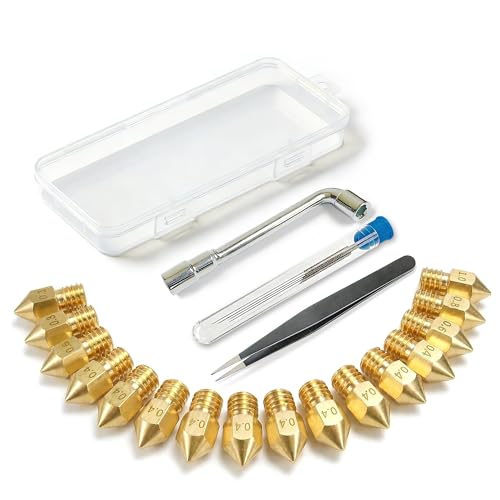
- LKNNEASTO
3D Printer Nozzle Kit, 16PCS MK8 Brass Nozzles 0.2/0.4/0.6/0.8/1.0mm
$7.19 Check pricePrices change often - Mudder
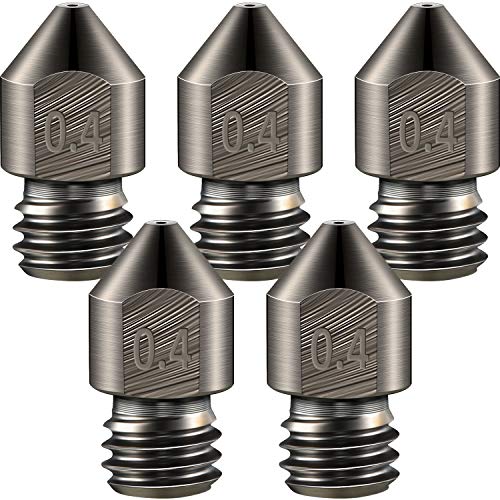
Mudder 5 Pcs Hardened Steel Nozzles 0.4mm Mk8 3D Printer Nozzles
$8.49 Check pricePrices change often - XIFOWE
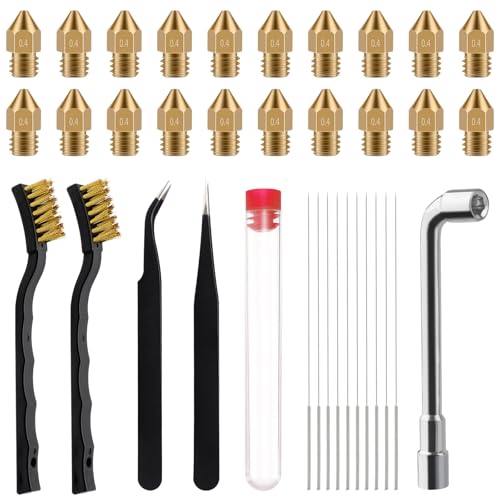
XIFOWE MK8 Nozzles 25 pcs 0.4mm 3D Printer Extruders Brass Nozzles
$9.99 Check pricePrices change often


Common questions
What is the default layer height for a 0.4 mm nozzle?
The everyday default is 0.20 mm, half the nozzle diameter. The usable range for a 0.4 mm nozzle runs from about 0.10 mm, for the smoothest surfaces and finest vertical detail, to about 0.30 mm, for faster prints with more visible layer lines. Both ends of that range are common, valid choices depending on the part.
Why does my print under-extrude at high speed even though the nozzle is not clogged?
The hotend likely cannot melt plastic fast enough to keep up with the volumetric flow the settings are demanding. Layer height multiplied by line width multiplied by speed can exceed a stock hotend's roughly 12 mm3/s ceiling well before the mm/s number looks unreasonable on its own. Lowering speed, layer height or line width brings the demand back under the hotend's limit.
Does a bigger nozzle mean I need a taller layer height?
It allows one, but does not require one. A larger nozzle raises the maximum layer height that can bond properly, since that ceiling is tied directly to nozzle diameter, but a shorter layer height within the usable range still prints fine on a large nozzle. The nozzle sets the ceiling; the desired surface finish sets where in that range to actually print.
Is line width the same thing as nozzle diameter?
No. Nozzle diameter is a fixed physical opening. Line width is a slicer setting, typically about 1.1 times the nozzle diameter, describing how wide each extruded strand of plastic is. Line width can be adjusted somewhat wider than that default for stronger, faster walls, but it cannot go meaningfully narrower than the nozzle diameter itself.
Why does TPU need such different slicer settings than PLA?
TPU flows through a hotend at only around 35 percent of the rate PLA does, so settings copied directly from a PLA profile will ask for more flow than TPU can deliver at that temperature. Slicer profiles for TPU typically lower speed substantially rather than changing layer height or line width, since flexible filament is also more prone to buckling when pushed too fast.