Best flexible TPU filament
Quick answer
The SUNLU TPU 95A 1 kg spool ($21.99, $21.99 per kilogram) is a reasonable first flexible spool. All three spools compared here share the same 95A hardness rating, so print difficulty is similar across brands and the deciding factor is mostly price and printer compatibility.
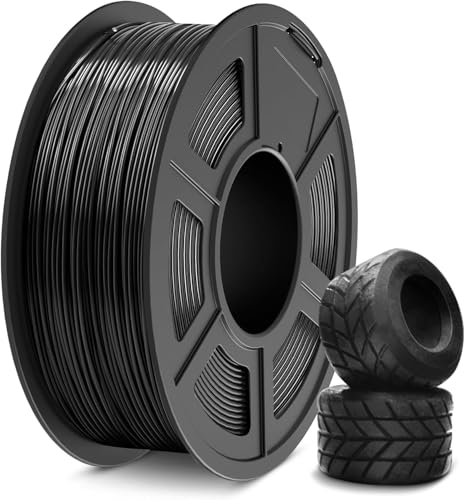
SUNLU TPU Filament 1.75mm,(1kg,Black,95a TPU)
A 95A hardness rating is the easiest flexible filament to print, and this spool sits at the lower end of the price range compared here at $21.99 per kilogram.
The three tiers
Beginner: Best first flexible spool
someone printing a flexible material for the first time, likely a phone case, gasket or gripSUNLU TPU is rated 95A, the firmer end of the flexible filament range and generally the easiest shore hardness to print, since softer TPU tends to buckle inside a bowden tube or jam in an extruder gear. At $21.99 per kilogram it is priced in line with the other 95A spools in this roundup, so there is no cost penalty for choosing an easier-to-print option.
Not for: anyone who specifically needs a softer, more rubber-like flexible material; 95A is noticeably firmer than the shore hardness used for phone grips or shoe soles in industrial 3D printing
Intermediate: Best value for direct-drive printers
a printer owner with a direct-drive extruder who wants consistent diameter for thin-wall flexible parts- Intermediate pick
OVERTURE TPU 95A Flexible 3D Printer Filament 1.75mm, 1kg Black
$22.99 Check pricePrices change often

OVERTURE is an established filament brand known for tight diameter tolerance, which matters more with TPU than with rigid filaments since a direct-drive extruder has to grip a softer material consistently to avoid under-extrusion. At $22.99 per kilogram it is close in price to the beginner pick above while adding brand consistency for anyone printing flexible parts regularly.
Not for: a bowden-style printer with the extruder motor mounted away from the hotend; TPU tends to buckle in the length of tubing between the extruder and nozzle on a bowden setup regardless of filament brand
Expert: Performance ceiling for precision flexible parts
someone printing thin-walled or tightly toleranced flexible parts, like gaskets or snap-fit enclosures, on a direct-drive printer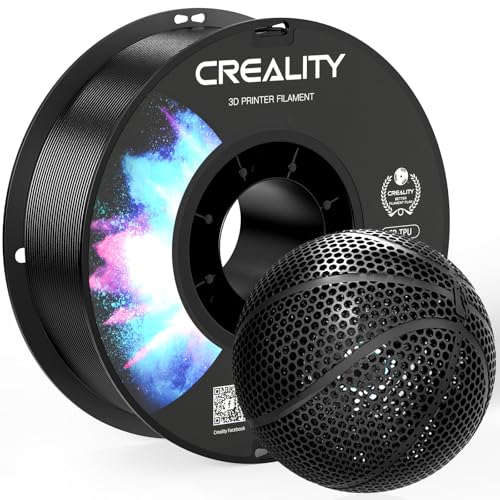
This spool is listed with a stated dimensional accuracy of plus or minus 0.03 millimeters and higher hardness and resilience than a standard 95A blend, which matters for a part that needs to hold a tight seal or a precise snap-fit feature. At $23.99 per kilogram it costs slightly more than the other two picks for that added consistency.
Not for: anyone printing a bowden-drive printer, or anyone printing large, simple flexible shapes where extreme dimensional accuracy adds no real benefit. Do not buy this spool if a phone case or basic gasket is the whole project; the cheaper 95A spools above do that job for less.
| Spool | Hardness | Price | Price per kg | Best for |
|---|---|---|---|---|
| SUNLU TPU 95A 1 kg | 95A | $21.99 | $21.99 | First flexible spool |
| OVERTURE TPU 95A 1 kg | 95A | $22.99 | $22.99 | Direct-drive printers, consistent diameter |
| Creality TPU 95A 1 kg | 95A | $23.99 | $23.99 | Tight-tolerance parts, stated +/- 0.03mm accuracy |
What can TPU print that a rigid filament cannot?
TPU is used for parts that need to flex, compress or grip without cracking: phone cases, cable sleeves, gaskets, vibration dampeners and wearable straps. A rigid filament like PLA or PETG will crack or snap under the same repeated bending that TPU is designed to absorb, which is why TPU exists as a separate material category rather than just another color option.
Why does TPU jam more often than PLA?
TPU is soft enough to compress under pressure rather than feed cleanly, which shows up as clicking or skipping in the extruder gear, or as the filament buckling and jamming inside a bowden tube before it reaches the hotend. A direct-drive extruder shortens that failure-prone path significantly, and slowing down print speed gives the softer material more time to feed consistently.
Do all TPU spools print the same way?
No. Shore hardness is the biggest variable: a 95A spool prints closer to a rigid filament's behavior than a softer 85A or 60A spool does, which is why 95A is the common recommendation for a first flexible filament and why all three spools in this roundup share that rating. Diameter consistency is the second variable; a spool with looser tolerance will under- or over-extrude even at the correct temperature and speed settings.
How we chose
This roundup is researched from catalog listings and manufacturer-published specifications, not from in-person testing. Every product named is checked against PrintFarmCalc's own catalog of verified Amazon listings, and every price-per-kilogram figure is calculated from the listed pack weight and price rather than taken from marketing copy.
All three spools compared here are rated 95A, the most commonly recommended hardness for a first flexible filament, so the deciding factors between tiers were price per kilogram and any stated dimensional accuracy claim, since diameter consistency affects flow more with TPU than with rigid filaments.
Buying tips
Why does extruder type matter more with TPU than with PLA?
TPU is soft enough to compress or buckle under the pushing force of an extruder gear, especially inside the length of tubing on a bowden-style printer where the extruder motor sits away from the hotend. A direct-drive extruder, where the motor sits right at the hotend, has a much shorter path for the filament to buckle in and is the more reliable setup for printing TPU.
What does a 95A hardness rating mean?
The number refers to the Shore A hardness scale, used to rate how firm or soft a flexible material is. A 95A TPU is firmer and closer to a hard rubber sole, while lower numbers like 85A or 60A are progressively softer and closer to a rubber band. All three spools in this roundup are 95A, which prints more predictably than softer ratings.
Does TPU need slower print speeds?
Yes. TPU generally needs a slower print speed than PLA or PETG because the material needs more time to be pushed consistently through the nozzle without buckling. Most printers need a dedicated flow rate and speed profile for TPU rather than reusing a PLA profile.
How much filament comes on a 1 kg spool of TPU?
TPU has a published density of about 1.21 grams per cubic centimeter. At a standard 1.75 mm diameter, that works out to roughly 344 meters of usable filament per kilogram, slightly more length than PETG at the same weight because TPU is a less dense material.
Other options worth knowing about
- ELEGOO
ELEGOO ABS 3D Printer Filament 1.75mm Black 1KG Strong Layer Adhesion
$16.99 Check pricePrices change often - Polymaker
Polymaker ABS Filament Black 1KG 1.75mm, Heat Resistant, Strength
$17.10 Check pricePrices change often


Common questions
What is the easiest TPU hardness to print?
A 95A shore hardness is generally the easiest flexible filament to print, since it behaves closer to a rigid filament than softer ratings like 85A or 60A. All three spools compared in this roundup are rated 95A for that reason. Softer ratings feel more like rubber but are more prone to buckling and jamming, especially on a bowden-style extruder.
Can I print TPU on a bowden-style printer?
It is possible but harder than on a direct-drive printer. The length of tubing between a bowden extruder's motor and the hotend gives soft TPU room to buckle and jam under pushing pressure. Slower print speeds and a firmer 95A hardness both help, but a direct-drive extruder remains the more reliable setup for consistent flexible printing.
Why is my TPU print under-extruding or looking stringy?
Under-extrusion with TPU is often a speed problem rather than a temperature problem: printing too fast does not give the soft filament time to feed consistently through the extruder gear. Slow the print speed first, then check that retraction distance is set low, since long retractions can pull soft TPU out of the extruder gear's grip entirely.
How much filament is on a 1 kg spool of TPU?
Using TPU's published density of about 1.21 grams per cubic centimeter and a standard 1.75 mm diameter, a 1 kg spool yields roughly 344 meters of usable filament. That is a bit more length per kilogram than PETG or ABS-CF blends at the same weight, since TPU is a comparatively light material.
Is a more expensive TPU spool worth it over a cheaper one?
Only if it solves a specific problem. A spool with a stated dimensional accuracy figure, like plus or minus 0.03 millimeters, is worth the extra cost for tight-tolerance parts such as gaskets or snap-fits. For a basic phone case or a simple flexible bracket, the cheapest 95A spool with a reasonable brand reputation does the same job for less.