Resin vs filament: which costs less per part
Quick answer
Filament is cheaper per finished part than resin. A 1 kg spool of SUNLU PLA ($13.99) prints dozens of similarly sized parts with almost no waste, while a resin part of the same size starts with a comparable per-kilogram price, such as ANYCUBIC 405nm resin ($15.19/kg), then adds isopropyl alcohol for washing and, on angled prints, supports that can add 30 to 60 percent to the model volume. Those two extras are what make resin the more expensive material to run, not the bottle price.

SUNLU PLA 3D Printer Filament, Black, 1KG
everyday functional parts and anyone who wants the lowest cost per finished part
| Filament (FDM) | Resin (MSLA/LCD) | |
|---|---|---|
| Raw material price | Roughly $14 to $24 per kilogram for common filaments | Roughly $15 to $35 per kilogram for standard resins |
| Density | 1.24 g/cm3 for PLA | About 1.1 g/cm3 |
| Support waste on angled prints | Usually a small fraction of model volume | Often adds 30 to 60 percent of model volume |
| Recurring consumable | None required | Isopropyl alcohol for washing, used up and replaced |
| Failed print cost | Filament only, cheap to reprint | Resin, plus wasted IPA and cure time |
| Handling and disposal cost | None | Nitrile gloves, ventilation, and proper disposal of used IPA |
Why does resin cost more per part than filament when the bottle prices look similar?
The per-kilogram price of resin and filament is not that far apart, so on paper the materials look close. What actually separates the two is everything resin needs beyond the bottle: isopropyl alcohol to wash every print before it is cured, and supports that on angled or overhanging prints can add 30 to 60 percent to the volume of resin a model actually consumes. Filament printing rarely needs anywhere near that much support material for a comparable part.
Add up a real print run and resin comes out more expensive per finished part almost every time, even though the sticker price per kilogram suggested otherwise.
Is a kilogram of resin the same amount as a kilogram of filament?
By weight, yes, a kilogram is a kilogram. Where people get tripped up is when resin is sold or measured by volume instead: resin has a density of about 1.1 g/cm3, so a milliliter of resin is not a gram. A 100 mL amount of resin weighs about 110 grams, not 100. If you are converting a bottle labeled in milliliters into a cost-per-gram figure to compare against filament, using the milliliter number as if it were grams will understate your real cost by about 10 percent.
PLA filament, by contrast, has a density of 1.24 g/cm3 and is normally sold and priced by weight already, which is one reason filament cost math tends to be simpler and harder to get wrong.
What does isopropyl alcohol actually add to the cost of a resin print?
Every resin print needs to be washed in isopropyl alcohol before it is cured, and that IPA gets progressively contaminated with dissolved resin as you use it, which means it needs replacing on a schedule rather than being a one-time purchase. A gallon of 99 percent IPA, such as a Five Star Materials Resources gallon ($26.99), is a real recurring line item in a resin workflow, and it is one that a filament printer never touches.
Used IPA also is not something to pour down a drain once it is contaminated. It needs to sit in a sealed, labeled container until the dissolved resin has a chance to cure out, then be disposed of as solid waste rather than liquid waste.
Do supports really add that much extra resin to a print?
Yes, and it depends heavily on the angle of the model. A print oriented to minimize overhangs might need very little support material, but a model with steep angled surfaces, which is common with miniatures and detailed figures, can need supports amounting to 30 to 60 percent of the model volume itself. All of that support material is resin you paid for and then threw away.
Filament printing uses supports too, but they are typically a much smaller fraction of the total print and can often be avoided entirely with a better print orientation, which keeps the material cost gap between the two processes wider than the raw price tags suggest.
When is resin worth the extra running cost?
Resin earns its higher cost per part when the part genuinely needs the detail level only resin delivers, such as miniatures, jewelry patterns or dental and medical models where filament layer lines would ruin the result. For anything that just needs to be functional or decorative at a normal viewing distance, the extra cost of IPA and support waste is not buying you anything filament could not already deliver more cheaply.
Resin (MSLA/LCD)
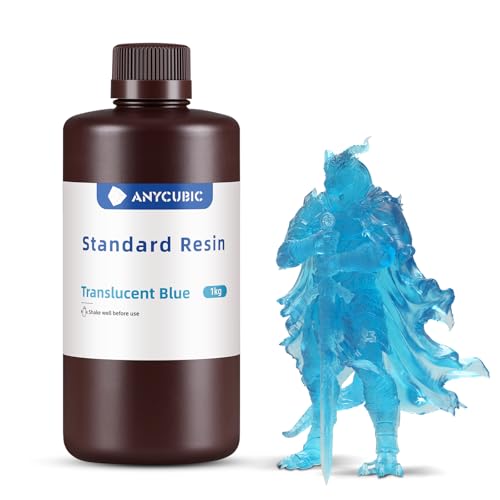
ANYCUBIC 3D Printer Resin, 405nm SLA UV-Curing Resin with High Precision and Quick Curing & Excellent Fluidity for LCD 3D Printing (Clear Blue, 1kg)
fine-detail parts where surface finish matters more than running cost
Both sides of this comparison
- ELEGOO
ELEGOO ABS 3D Printer Filament 1.75mm Black 1KG Strong Layer Adhesion
$16.99 Check pricePrices change often - Polymaker
Polymaker ABS Filament Black 1KG 1.75mm, Heat Resistant, Strength
$17.10 Check pricePrices change often


Safety
Common questions
Is resin more expensive than filament overall, or just per part?
Both, once you count consumables. The raw material price per kilogram is similar, but resin adds isopropyl alcohol as an ongoing cost and often loses 30 to 60 percent of a print to supports on angled models. Filament has neither of those recurring costs, which is why resin ends up more expensive per finished part even when the bottle price looks competitive.
Why is a 100 mL amount of resin heavier than 100 grams?
Resin has a density of about 1.1 g/cm3, so a milliliter of resin weighs slightly more than a gram. A 100 mL amount weighs about 110 grams. If you calculate cost per gram using the milliliter figure as though it were grams, you will understate the real cost by roughly 10 percent, which matters when comparing against filament priced by weight.
Can I reuse isopropyl alcohol for washing multiple resin prints?
Yes, up to a point. IPA can wash several prints before it becomes too saturated with dissolved resin to clean effectively, at which point prints come out still tacky. Once it reaches that point it needs to be retired, left to cure in sunlight in a sealed container, and disposed of as solid waste rather than poured down a drain.
Does filament printing have any recurring consumable cost like IPA?
Not really. Filament printing consumes the filament itself and occasionally a build plate adhesive like glue stick, but there is no liquid consumable used up on every single print the way IPA is used in resin washing. This is one of the clearest reasons filament has a lower and more predictable running cost.
Can I lower resin running costs by reducing supports?
Yes, orientation matters a great deal. Angling a model to reduce steep overhangs can meaningfully cut the amount of support material a slicer generates, sometimes well below the 30 to 60 percent figure typical of a poorly oriented print. It will not eliminate the isopropyl alcohol cost, but it directly reduces the resin wasted on supports.